The Addict's Loop
A different way of understanding addiction.
For thousands of years, humanity has carried fear in silence, pressing it deep into the unconscious in order to survive. Picture a man alone in a dark room, isolated, trembling, unseen. Faced with this unbearable imbalance, the psyche creates a savior from the shadows, a presence meant to lift him out of darkness and return him to safety. From this moment, two roles are born in the unconscious: one who rescues, and one who needs to be rescued.
When these two roles meet, they ignite a euphoric connection. The savior feels powerful, needed, whole. The fearful man feels rescued, protected, relieved of his isolation. Yet this union lives entirely in the unconscious. Man does not know he has created these roles from his repressed fear. He only feels the rush of relief when they connect, and the ache when they separate. I have named these two codependent roles the Controller and the Dependent.
Because the connection is created in the unconscious and built on repression, it cannot last. The rescue fades, and both roles fall back into fear and a deep longing to connect. This endless swing between euphoric union and painful abandonment becomes a closed circuit in the psyche. It is the rhythm of addiction itself. It is the Addict’s Loop.
Now introduce a substance into this unconscious loop. The drug becomes a false savior, lifting the fearful man briefly out of darkness into a euphoric sense of connection, safety, and power. The rescue mission feels complete.
But it never lasts. When the substance fades, the fall is brutal. Fear, isolation, and terror return amplified. The unconscious remembers the relief and reaches again for the drug. What began as survival becomes a closed system of destruction. The man is no longer choosing the drug, the loop is choosing him.
The addict inherits both codependent roles, the Controller and the Dependent, creating a destructive loop within the unconscious. Most people inherit one codependent role, either the Controller or the Dependent, and gravitate toward the opposite role, recreating the Addict’s Loop within their relationships.
During the 1940s, alcoholics were often called “King Babies,” or “Queen Babies” in the case of women. Unknowingly, this stigma was naming the two codependent roles the alcoholic inherits. Other descriptions included “ego maniacs with an inferiority complex,” again pointing to the same two unconscious roles that rotate within the addict.
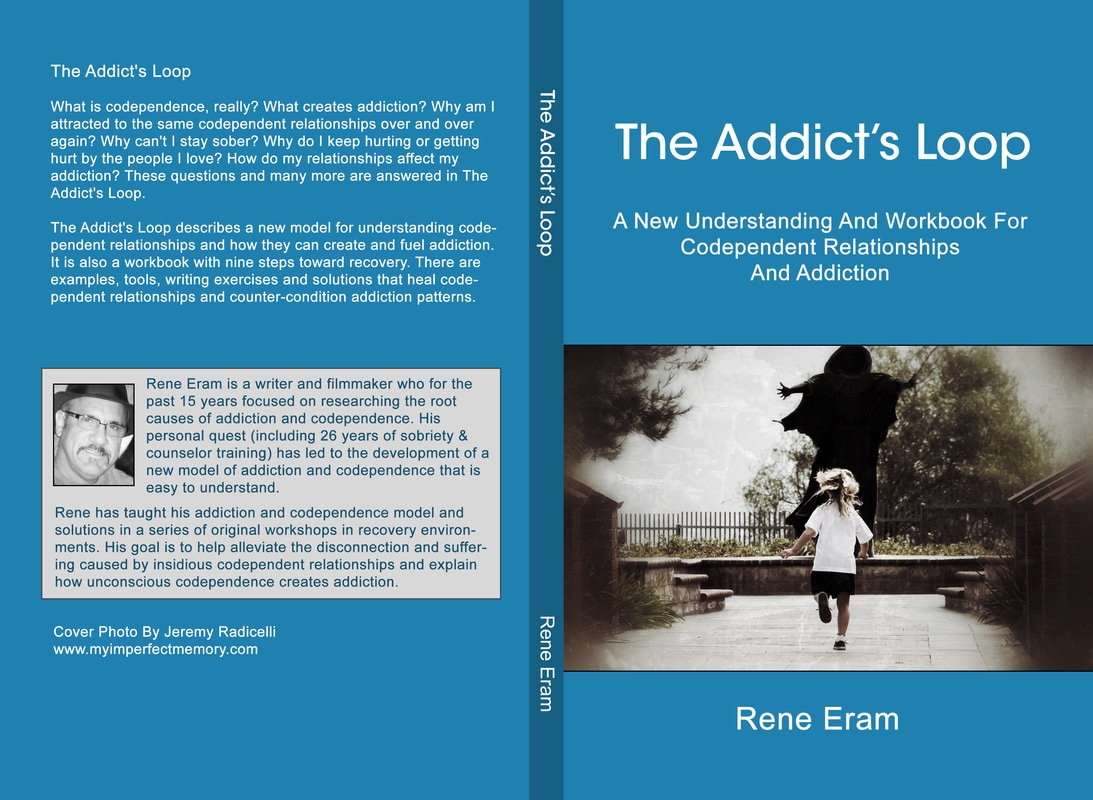
My book "The Addict's Loop" is available on Amazon > The Addict's Loop
Visit my Facebook page The Addict's Loop where you can post comments and ask questions.
My book the Addict's Loop describes in detail my codependence and addiction model and then creates a path out through a nine step counter-conditioning process. There are many questions to answer, exercises, tools, and solutions.
I have been sober since August 1st, 1987. Over my years of sobriety, I have created and taught a series of original workshops on spirituality, addiction and codependence.
I believe I was an addict long before I ever took my first drink and have struggled with codependent relationships all my life. For the past three decades, it has been my mission to unravel the deep unconscious connection between codependence and addiction. In my book I describe in detail their mechanics and unconscious patterns. Rene Eram
copyright 2025